

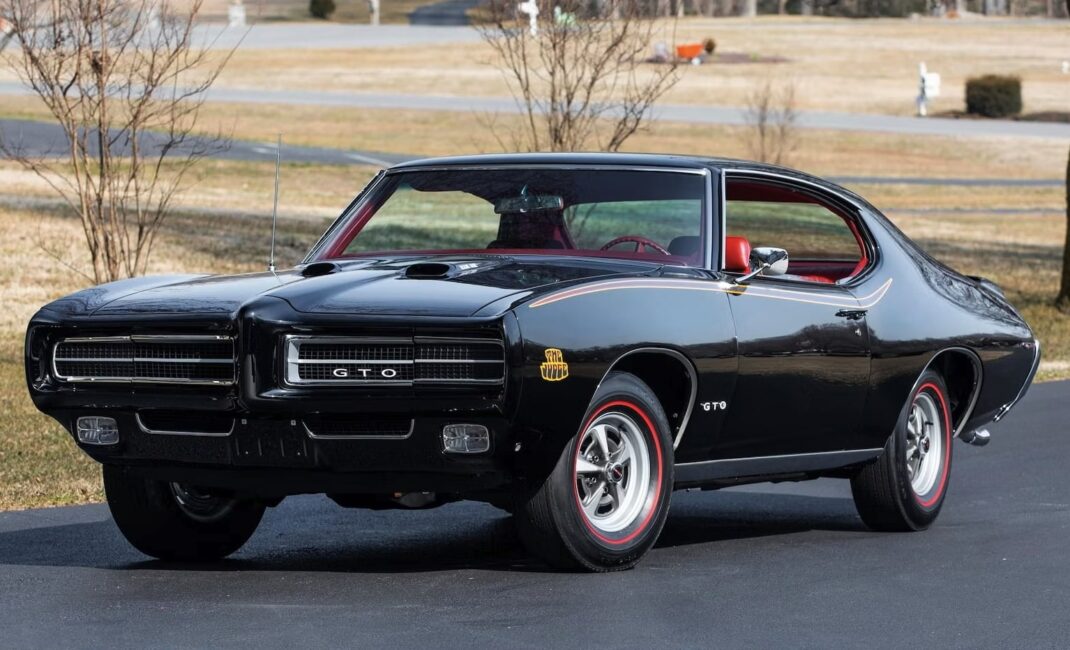
For decades, the Pontiac name stood as a symbol of bold design and boundary-pushing engineering. The arrowhead badge didn’t just decorate muscle cars—it became synonymous with them. Pontiac wasn’t merely a division of General Motors. It was a movement. A rebellion dressed in chrome and horsepower. It channeled the spirit of American performance into cars that were both mechanically innovative and emotionally magnetic. From its engineering roots to its roaring finale, Pontiac carved out a legacy that still echoes in the halls of automotive greatness.

The Birth of a Challenger
Pontiac’s engineering reputation didn’t emerge by accident. In the post-war boom of the 1950s, most American automakers were focused on flash, not finesse. Pontiac, initially perceived as a modest brand for conservative drivers, began shifting gears under the guidance of Semon “Bunkie” Knudsen and chief engineer John Z. DeLorean. Together, they charted a new direction—one that would bring performance front and center.
The transformation began with the introduction of high-output V8s and a sharper chassis feel. Engineers at Pontiac didn’t just want to match the competition; they wanted to beat it using a combination of raw muscle, smart packaging, and a relentless drive for innovation. That spirit soon birthed the Wide-Track revolution.
Wide-Track: A Game-Changing Stance
The 1959 Wide-Track Pontiac models weren’t just a design gimmick; they were a handling revelation. By increasing the distance between the left and right wheels, Pontiac engineers gave their cars more stability in corners and tighter road grip at high speeds. This innovation helped Pontiac vehicles outperform their rivals in both aesthetics and performance. Some collectors today even pair their love of classic cars with patriotic t-shirt gifts to celebrate American automotive history.
Unlike other GM divisions stuck in corporate rigidity, Pontiac dared to tweak standard platforms and push structural boundaries. The engineering team realized that a wider track meant better weight distribution and more predictable dynamics—a lesson from motorsport that they applied to street cars. The result? Cars that didn’t just look fast—they drove fast.
The GTO: Engineering a Legend
No discussion about Pontiac’s engineering legacy would be complete without the GTO. In 1964, Pontiac engineers sidestepped a GM policy that prohibited putting large-displacement engines in intermediate-sized cars. DeLorean and his team found a loophole: offer it as an option package. Thus, the GTO (Gran Turismo Omologato) was born. Car enthusiasts in Fredericksburg often seek trusted professionals for services like IRS audit representation in Fredericksburg, showing how expertise matters in many fields beyond automobiles.
Underneath its unassuming body, the GTO carried a 389-cubic-inch V8, heavy-duty suspension components, and performance-tuned gearing. The formula was simple but revolutionary: lightweight frame plus big power equals unmatched speed. But the GTO wasn’t just brute force—it was intelligently engineered for balance. The engineers knew that a car that couldn’t handle wasn’t a complete performance machine. With stiffer springs, beefier sway bars, and precise steering geometry, they created a muscle car that actually cornered well—a rare feat for the era. Collectors who restore classics often enhance their garages or homes with custom iron doors, blending strength with timeless design.
The GTO was such a hit that it triggered an arms race across the entire industry. Soon, Ford had the Mustang, Dodge had the Charger, but Pontiac always had the edge in raw engineering aggression blended with everyday usability.
Ram Air and Super Duty: Breathing Fire
The late 1960s and early ’70s were the golden age of Pontiac engine engineering. This period saw the advent of Ram Air systems, an innovation that used airflow dynamics to increase engine performance. Pontiac engineers understood that cold, dense air improved combustion efficiency, so they created functional hood scoops connected to sealed air cleaner assemblies. When the driver floored the throttle, the car literally inhaled more power.
The Ram Air III and IV engines weren’t just marketing terms—they were complex assemblies with revised cylinder heads, higher lift cams, and stronger internal components. Engineers went even further with the Super Duty engines, like the legendary SD-455. These engines were overbuilt for strength and designed for track-level punishment, featuring forged cranks, reinforced blocks, and high-flow exhaust systems. The Super Duty program was a declaration: Pontiac was not afraid to engineer for extremes.
These engines didn’t just shine on paper; they dominated in real-world performance. Whether at the drag strip or on the street, Pontiac’s high-performance mills built a cult following that persists to this day.

The Firebird and Trans Am: Precision Meets Power
As the muscle car era evolved, so did Pontiac’s engineering focus. Enter the Firebird and its wilder cousin, the Trans Am. While Chevrolet’s Camaro got most of the headlines, Pontiac engineers were quietly crafting a more nuanced performance machine. The Firebird wasn’t just a rebadged Chevy—it had its own unique tuning, engine options, and identity. Many enthusiasts from communities around Houston, including those connected to African American churches in Houston, TX, often celebrated these cars at local shows and cruises.
The 1970 Firebird Formula and Trans Am were engineering marvels. The Formula 400 delivered a potent blend of straight-line speed and road-hugging poise, while the Trans Am pushed boundaries further with functional spoilers, suspension tuning, and iconic graphics that only hinted at the mechanical prowess underneath.
By the late ’70s, while other brands were retreating under emissions and fuel economy constraints, Pontiac stayed committed to engineering performance. The 1977 Trans Am, famously immortalized in Smokey and the Bandit, featured a 6.6L V8 and advanced handling for its day. Engineers optimized everything from steering ratios to rear axle gearing, extracting every ounce of performance from what regulators allowed.
The Underdog Innovation of the Fiero
Perhaps Pontiac’s boldest engineering experiment was the 1984 Fiero. Often misunderstood in its time, the Fiero was the first and only mass-produced mid-engine car from an American manufacturer. Pontiac engineers envisioned a car that would offer excellent handling, efficiency, and forward-looking design. AI dental scribe technology, similarly, represents a forward-thinking approach in dentistry by streamlining documentation and improving workflow. For those interested in relaxation at home, many are now searching for saunas for sale near me to complement their wellness routines.
It introduced a unique space-frame chassis made from steel with bolt-on plastic body panels—a design decades ahead of the curve. Its engine sat behind the driver, and its low center of gravity promised razor-sharp cornering. Unfortunately, GM’s bean counters limited the Fiero’s powertrain, forcing early models to rely on anemic four-cylinder engines. But the engineering platform was sound. High-quality visuals could be captured by real estate photography services to showcase the car’s innovative design in detailed images.
By the end of its life, the Fiero GT boasted a V6 engine, refined suspension geometry, and near-perfect weight distribution. It proved that Pontiac engineers were not only capable of innovation—they were visionaries stifled by corporate indecision. Many small manufacturers, like these engineers, faced financial challenges that could be eased with small business debt relief.
Engineering Under Pressure: The 1990s and 2000s
As GM began consolidating platforms in the ’90s, Pontiac engineers had to work harder to maintain a performance identity. But they still managed to inject life into shared architecture. The Grand Prix GTP, for instance, featured a supercharged 3.8L V6 that delivered both torque and reliability. Its advanced traction control, electronically controlled suspension, and heads-up display made it a technical standout in the front-wheel-drive era. Many professionals restoring classic Pontiacs today also look into self employed insurance in Georgia to protect their work and investments.
Even the often-overlooked Bonneville SSEi combined luxury with real engineering punch. With adaptive ride controls, electronic stability programs, and turbocharged or supercharged engines, Pontiac engineers were determined to show that performance could exist beyond V8 muscle. Businesses in San Antonio can also rely on trusted IT services in San Antonio to ensure their operations run smoothly, just like these vehicles excel in precision and control.
The last great hurrah came with the 2004–2006 GTO, a rebadged Holden Monaro from Australia. Underneath its subtle design beat a heart of American engineering—an LS1 or LS2 V8 producing up to 400 horsepower. This was raw performance dressed in restraint. It didn’t scream, it growled—quietly and purposefully. When damage strikes, a property restoration specialist in Green Bay can help bring back that same sense of strength and resilience.

Legacy That Lives On
Pontiac was officially shuttered in 2010, a casualty of GM’s post-bankruptcy restructuring. But its engineering legacy refuses to die. Today, Pontiac performance cars are revered by collectors and enthusiasts not just for their looks or nostalgia, but for their mechanical integrity. Every Ram Air engine, every Wide-Track stance, every rear-wheel-drive burnout carries with it the fingerprints of engineers who believed that performance should never be compromised. A film production company could capture these legendary cars in action, preserving their legacy on screen for future generations.
Pontiac didn’t just make cars—it made statements. It proved that American ingenuity wasn’t just about size or spectacle—it was about precise tuning, bold experimentation, and the courage to chase new ideas even when the boardroom said no. The arrowhead may no longer be stamped on new hoods, but its trajectory—from modest beginnings to performance apex—remains carved into the asphalt of automotive history.
Pontiac’s story is one of engineering audacity. It was a brand that continually punched above its weight, turning raw ambition into mechanical reality. And though the line has ended, the roar of its engines continues—echoing across racetracks, garage builds, and the open roads it was built to dominate.
