


Land Rover has built its reputation on the promise that no terrain is off-limits. From the early Series I models to today’s sophisticated off-road machines, the brand has consistently pushed the boundaries of what a vehicle can do when the pavement ends. Yet no innovation has shaped Land Rover’s modern identity more than the Terrain Response system, a driver-assist technology engineered to translate complex environmental challenges into intuitive vehicle behavior. While many automakers offer off-road modes, none mirror the precision, adaptability, and depth of engineering that make Terrain Response feel like a co-pilot. Understanding how it works reveals a layered combination of mechanical strength, software intelligence, and real-time sensor feedback that transforms rugged terrain into manageable pathways.

The Engineering Philosophy Behind Terrain Response
Terrain Response wasn’t born from marketing ambition but from a very specific engineering question: How can a vehicle adapt its mechanical and electronic systems faster and more accurately than even the most experienced driver? The goal was not simply to provide selectable driving modes, but to create an integrated command network that allows the car to make micro-adjustments before the driver even feels the need to intervene.
Engineers approached this with the mindset used in aerospace and robotics design. They analyzed how human drivers interpret terrain—through vibration, resistance, wheel slip, and visual cues—and then asked how sensors and controllers could replicate and even surpass this sensory input. From that concept emerged an architecture where the drivetrain, engine management, suspension system, braking modules, and traction controls communicate through a high-speed digital network. This linkage allows Terrain Response to orchestrate changes across multiple vehicle systems simultaneously, something impossible with traditional mechanical controls alone.
The engineering philosophy prioritized predictive adaptation, meaning the system doesn’t merely react to obstacles but anticipates them. When a sensor detects loose gravel or a subtle incline change, Terrain Response begins altering torque distribution and throttle sensitivity before the driver notices the shift. This foundational idea is what separates Land Rover’s system from simpler “off-road mode” toggles found elsewhere.
How the Vehicle Reads the Environment
Terrain Response relies on a network of sensors that constantly analyze the ground beneath the vehicle. Wheel-speed sensors monitor slip and traction variation across each tire. Yaw and pitch sensors detect the vehicle’s rotation and body angle, essential for determining whether the car is climbing, descending, or crossing a slope at risk of lateral drift. Suspension height sensors measure how the vehicle is loading or unloading weight, and steering-angle sensors help the system predict the path the driver is attempting to take.
These sensors feed into a central processing unit that acts as the brain of the system. Engineering this unit required an emphasis on processing speed. Because terrain changes within fractions of a second, the system must compute feedback and send instructions to components like the throttle, differential locks, and traction control almost instantaneously. Even a brief delay could compromise stability or traction.
To achieve this, Land Rover engineers implemented high-bandwidth controller area networks that reduce latency and synchronize decision-making across modules. The result is a unified vehicle response rather than fragmented systems acting independently. Instead of the driver feeling traction control intervene after slip occurs, or the suspension adjusting after a jolt, Terrain Response aligns its commands so changes happen fluidly, maintaining balance and grip.
Engineering the Drive Modes
Terrain Response offers multiple modes such as Grass/Gravel/Snow, Mud and Ruts, Sand, Rock Crawl, and Auto. From the driver’s perspective, selecting a mode feels effortless. Underneath, however, choosing a mode triggers a deep set of engineering behaviors.
Grass/Gravel/Snow mode, for instance, demands extremely sensitive throttle calibration. Engineers programmed the system to reduce wheelspin by softening torque delivery and encouraging smoother input transitions. The braking system is tuned with higher slip-sensitivity thresholds so that the slightest loss of traction prompts micro-braking adjustments on individual wheels.
Mud and Ruts mode uses an entirely different approach. Here, torque needs to be more assertive. The system tightens differential lock engagement and adjusts the gearbox to hold lower gears longer, providing consistent power through thick, uneven surfaces. The traction control is relaxed slightly compared to snow mode because a controlled amount of wheelspin is necessary to clear mud buildup.
When Sand mode is engaged, the engineering shifts dramatically. Sand is one of the most demanding terrains because it can swallow torque and trap a vehicle quickly. Engineers responded by reprogramming throttle response to deliver more aggressive power. Wheelspin limits are raised intentionally to maintain momentum, and the gearbox prioritizes rapid shifts to keep the engine in a high-torque band. The system also pre-locks differentials more aggressively, preventing the vehicle from digging itself into soft sand.
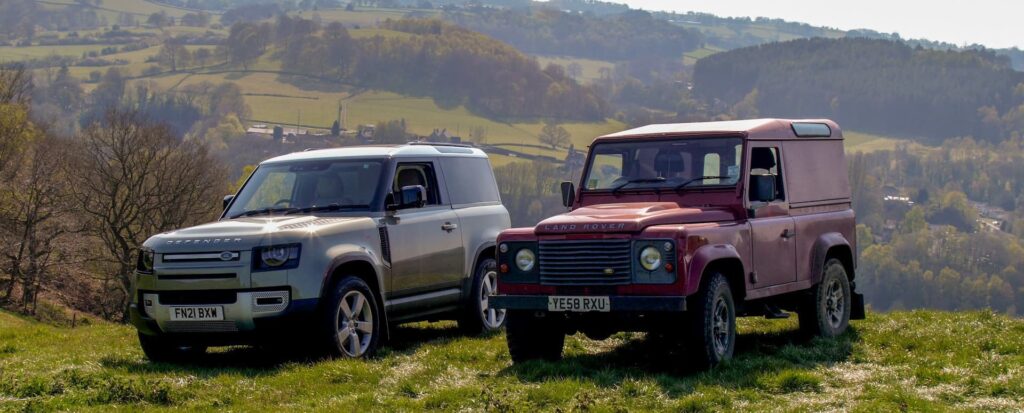
Rock Crawl mode is perhaps the most mechanically intensive. Precision, not momentum, defines success in rocky environments. Engineers calibrated the vehicle to hold a steady, low speed using controlled throttle mapping and enhanced hill descent logic. The suspension system adopts a firmer stance, maximizing wheel articulation and ground clearance. The braking system takes on a role similar to a climbing harness, applying precise, low-speed modulation so each wheel maintains grip even when one is airborne or transitioning across uneven surfaces.
Auto mode blends data from sensors to determine which terrain the vehicle is experiencing. This required the most sophisticated programming effort. Engineers developed algorithms capable of identifying unique traction signatures, vibration frequencies, and wheel-slip patterns so the system can decide whether the car is on gravel, mud, sand, or rock without driver input.
The Role of the Air Suspension System
Land Rover’s air suspension is a critical component that allows Terrain Response to function at its full potential. Unlike traditional coil suspensions, air suspension offers variable ride height and dynamic stiffness changes. Engineers integrated the suspension computer with the Terrain Response module so that ride height, damper firmness, and wheel articulation could be modified instantly.
In off-road scenarios, the system increases ground clearance, but it does more than raise the vehicle. The suspension also adjusts to prevent excessive body sway on uneven slopes. When the system detects a side-angle tilt, it compensates by stiffening the uphill side to stabilize the cabin and maintain wheel contact on the downhill side.
During rock crawling, the suspension adopts a soft articulation mode that encourages maximum vertical wheel travel. On sand, it firms up to reduce excessive bounce and maintain forward momentum. This level of responsiveness is possible only because the air suspension is electronically controlled and tightly integrated with Terrain Response’s logic.
How Torque Distribution Is Engineered for Precision
At the heart of off-road engineering is torque management. Land Rover engineers designed the Terrain Response system to manipulate torque distribution not only between axles but also between individual wheels through electronic differentials and braking systems.
The center differential relies on a multi-plate clutch capable of variable locking. Instead of choosing a simple locked or open state, the system can apply partial locking percentages, adapting to terrain conditions detected by sensors. This allows power to shift seamlessly, eliminating the abruptness typically associated with mechanical differential engagement.
Electronic rear and front differentials further enhance precision. When the system identifies wheel slip, it locks the appropriate differential preemptively. Because these locks are electronically controlled, engagement happens faster than mechanical diffs and can vary in intensity. This is especially crucial in rock crawling, where uneven surfaces constantly shift weight between wheels.
Software Engineering and Machine Learning Integration
Modern iterations of Terrain Response incorporate elements of machine learning. While the system does not operate as a fully autonomous AI, engineers have programmed it to refine its responses based on repeated patterns. Over time, it becomes better at identifying subtle terrain indicators such as vibration frequency signatures, wheel-slip cycles, and load transitions.
Software updates can adjust throttle curves, recalibrate braking sensitivity, and refine shift patterns. Because the Terrain Response platform is deeply software-driven, engineers can push improvements without redesigning mechanical components.
Why the System Feels Seamless to the Driver
The brilliance of Terrain Response lies not in its complexity but in its invisibility. Drivers don’t feel the constant adjustments happening beneath them. They experience a steady climb, a confident crawl, or a smooth glide across sand. Achieving this required engineers to eliminate the sense of intervention. Instead of abrupt traction control kicks or sudden suspension shifts, the system blends changes smoothly so the vehicle feels naturally capable, not electronically assisted.
This harmony of mechanical engineering, digital intelligence, and real-time adaptation is what makes Terrain Response one of Land Rover’s most defining technologies.

The Future of Terrain Response Engineering
As electrification becomes more central to automotive design, Land Rover’s engineering team is exploring new ways to integrate electric motors into off-road optimization. Electric torque delivery is instantaneous, which opens the door to even more precise control in challenging environments. Future Terrain Response systems may use motor-by-motor torque vectoring, advanced predictive modeling, and terrain-scanning lidar to create a new generation of off-road intelligence.
While technological components evolve, the core engineering principle remains unchanged: empower drivers to explore any landscape confidently and safely.
